22 Sep
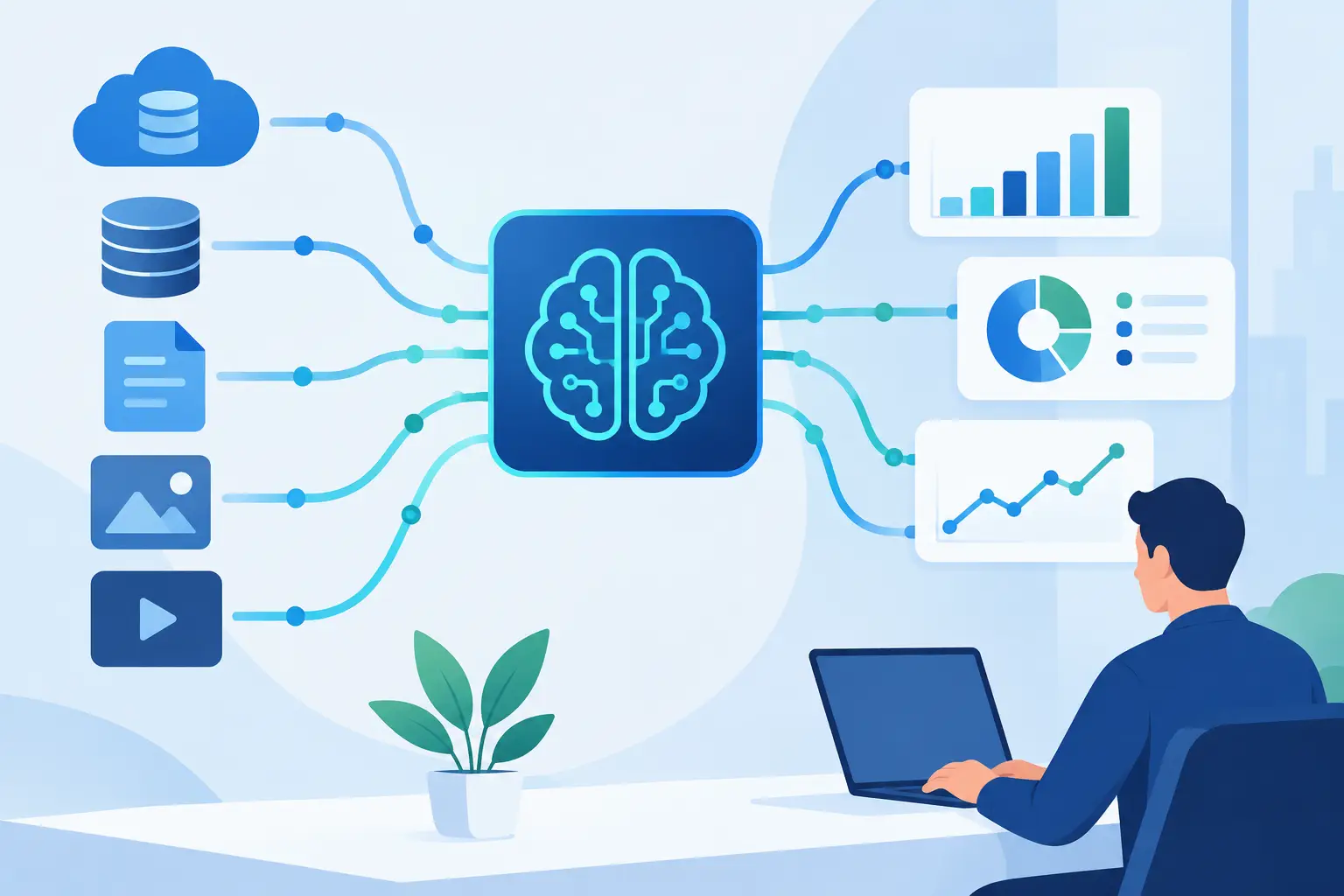
A customer enquiry arrives through a website form, an account manager adds notes to a CRM, stock levels change in an ordering system, and invoices land in a finance platform. For many businesses, these events still sit in separate places until someone manually joins the dots. AI data processing trends are changing that position, but the strongest opportunities are not about adding AI to every task. They are about making operational data more useful, reliable and timely.
For small and mid-sized businesses, the question is practical: where can AI reduce repetitive work, improve decisions or give teams a clearer view of what is happening? The answer depends on the quality of the data, the systems already in place and the cost of getting a process wrong. A well-designed solution should support the way your business operates, rather than force it into a generic workflow.
AI data processing trends moving into everyday operations
The most valuable changes are happening behind the scenes. AI is increasingly being used to classify, extract, match, check and route information before it reaches a person. This allows staff to spend less time copying data between systems and more time resolving exceptions, serving customers and acting on useful information.
Unstructured data is becoming operational data
Businesses have long been able to process information held in neat database fields, such as order numbers, dates and product codes. The harder problem has been handling emails, scanned documents, PDFs, call notes, photographs and free-text enquiries. These sources contain useful information, but they require manual reading and interpretation.
Modern AI models can identify key details in a supplier invoice, categorise a customer request, summarise a long report or flag a document that needs human attention. That does not mean every extracted field should be accepted automatically. A sensible process sets confidence thresholds: straightforward cases can move through quickly, while uncertain or high-value items are passed to a member of staff for review.
This is particularly useful where volume is high and formats vary. A bespoke processing system can take documents from several sources, extract the required data and send validated results into accounting, stock, case management or customer service software. The commercial benefit comes from reducing delays and rekeying, not simply from using an impressive tool.
Real-time processing is replacing overnight batches
Many businesses still rely on reports generated at the end of the day or week. That can be sufficient for historical analysis, but it is less helpful when an urgent customer query, delivery issue or suspicious transaction needs a response now.
AI-supported data processing is moving towards event-based workflows. When an action occurs, such as a new order, a missed payment or an unusual change in demand, the system can assess the information and trigger the appropriate next step. It might alert a manager, create a task, request more evidence or update a dashboard.
Real-time processing has trade-offs. It requires clear rules, well-connected systems and careful consideration of what should happen automatically. For a low-risk query, immediate routing may be ideal. For a pricing decision, credit approval or compliance matter, AI should provide context and recommendations while an authorised person remains responsible for the final decision.
AI is being built into data quality work
Poor data is not a minor technical issue. Duplicate customer records, inconsistent product names and missing addresses create wasted effort across sales, finance, support and reporting. They also weaken any AI feature built on top of them.
One of the more useful AI data processing trends is the use of machine learning to detect likely duplicates, standardise values and identify anomalies. For example, a system may recognise that two records refer to the same organisation despite small differences in spelling, or spot that an order quantity is unusually high compared with normal purchasing behaviour.
The key word is likely. Data cleansing should not become a black box that silently overwrites business records. A good implementation records what has changed, preserves the original source where needed and gives users a straightforward way to correct mistakes. This creates confidence in the system and improves data over time.
The shift from reports to decision support
Traditional reporting explains what has already happened. AI can help teams interpret what that information may mean and decide where to look next. A sales manager may receive a view of accounts at risk of reduced spend. An operations manager may see likely pressure points in fulfilment. A service team may identify recurring causes of customer complaints.
The value lies in combining business data with the context of the process. A prediction on its own is rarely enough. Teams need to understand why a record has been flagged, which information influenced the result and what action is recommended. Explanations do not need to expose every technical detail, but they should be clear enough for a manager to make an informed judgement.
This is why generic dashboards often disappoint. They show standard charts but do not reflect how a particular business quotes work, schedules staff, manages stock or supports customers. Bespoke software can bring together the relevant data sources and present the next useful action in the context where staff already work.
Smaller, focused models are gaining ground
The largest general-purpose AI models receive most of the attention, yet they are not always the best fit for business data processing. A focused model or rules-assisted workflow can be quicker, cheaper and easier to control when the task is narrow, such as classifying incoming requests or checking document fields.
For organisations handling sensitive commercial or personal information, this approach can also make governance simpler. The solution can be designed around a defined purpose, approved data sources and known users. It is often more sensible than giving a broad AI tool unrestricted access to internal systems.
There is no single right architecture. Some tasks benefit from a general language model, particularly when interpreting varied text. Others are better handled by conventional data processing, deterministic business rules or a smaller machine learning model. The right solution uses each method where it is strongest.
Governance is becoming a design requirement
As AI becomes part of routine data processing, businesses need more than a policy document. They need practical controls built into the system. This includes deciding which data can be used, who can access it, how long it is retained and when a human review is required.
UK organisations must also consider data protection obligations, confidentiality and sector-specific requirements. If customer or employee data is involved, it is essential to understand where the data is processed and whether it is being used to train a third-party model. These questions should be answered before deployment, not after a useful pilot becomes embedded in daily work.
Audit trails matter too. When a system extracts information, recommends an action or changes a status, the business should be able to see what happened and when. This is valuable for compliance, but it is equally helpful when diagnosing an error or improving a workflow.
How to choose the right AI data processing project
Start with a process that is frequent, measurable and currently frustrating. It could be handling application forms, checking order data, sorting support requests or consolidating reports from several systems. Avoid beginning with a vague aim to use AI across the business. A specific operational problem gives the project a clearer scope and makes results easier to assess.
Before development begins, map the inputs, outputs and exceptions. Identify where the data comes from, who owns it, what a correct outcome looks like and what should happen when the system is uncertain. This work often reveals process issues that should be fixed regardless of the technology chosen.
Success should be measured in business terms. Consider reduced processing time, fewer manual corrections, faster response times, improved data completeness or a lower cost per transaction. Accuracy remains essential, but it must be judged against the risk of the task. An AI suggestion that saves a few minutes is not worthwhile if an error could damage a customer relationship or create a financial loss.
A phased approach is usually the safest route. Begin with a limited workflow, retain human oversight and use real operational feedback to refine the solution. Once the process is reliable, it can be integrated more deeply with the systems your team already uses.
The organisations likely to benefit most will not be those that chase every new AI feature. They will be the ones that treat data processing as a business capability: designed around real work, connected to the right systems and supported as requirements change. For businesses that need software built to their exact process, the most useful next step is to identify one data-heavy task where better information flow would make a visible difference.
Related Post