22 Sep
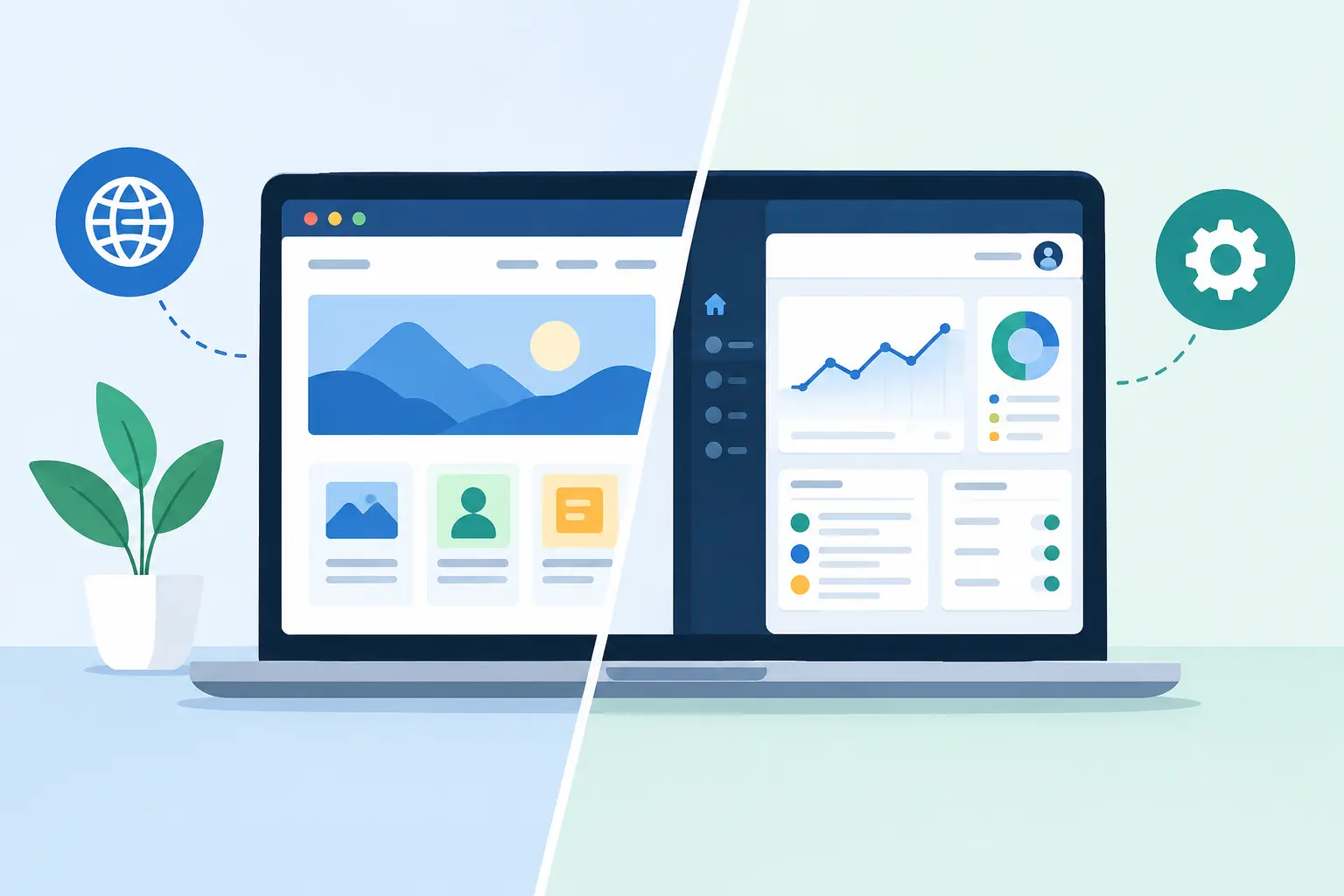
When clients ask us about websites versus web apps, they are rarely asking for a textbook definition. They want to know which investment will help them win customers, reduce manual work or give their team better control of a process that has outgrown spreadsheets, emails and disconnected tools.
The answer is not simply that a website is public and a web app is private. Many successful digital products sit somewhere between the two. The right choice depends on what users need to do, how your business operates and what needs to connect behind the scenes.
Websites versus web apps: the practical difference
A website primarily presents information. It may explain your services, showcase case studies, publish products, generate enquiries or take online payments. Its job is usually to guide visitors towards a decision: contact your business, request a quote, make a purchase or book a meeting.
A web app is designed for repeated interaction. Users sign in, view information specific to them, complete tasks and create or update data. It behaves more like business software delivered through a web browser than a conventional marketing site.
For example, a manufacturer’s website might show its capabilities, locations and contact details. Its web app might allow approved customers to place repeat orders, check production status, download technical documents and manage several delivery addresses. The website attracts and reassures; the app supports an ongoing working relationship.
The technologies behind both can overlap. A modern website may include a quotation form, a product configurator or an online shop. A web app can also contain public pages. The difference is the primary purpose, not the presence of a login screen or a particular programming language.
When a website is the right commercial choice
A well-planned website is often the best starting point when your main aim is visibility, credibility and lead generation. For a business that relies on enquiries, clear service pages, strong calls to action and a straightforward way to get in touch may produce more value than building a complex platform too soon.
An eCommerce website is also a website first, even though it handles transactions. Customers browse a catalogue, compare products, add items to a basket and pay. Administration may take place in a separate system, or it may be integrated with stock, accounting and fulfilment software as the operation grows.
Choose a website when most visitors need the same information and their journey is relatively simple. You may need content management so your team can update pages, forms that route enquiries to the right people, and reporting that shows which campaigns generate business. These features can be tailored without turning the project into a full software build.
A website is generally quicker and less costly to launch than a bespoke web app because it has fewer user roles, workflows and exceptions to account for. That said, a low-cost website can become expensive if it is built around unsuitable templates or plugins and later needs to support processes it was never designed to handle.
A website should not become a workaround
Problems begin when a website is asked to carry the weight of internal software. If staff are manually transferring orders from forms, maintaining duplicate customer records or chasing updates by email, the issue may not be web design. It may be a process that needs a proper application and integration.
When a web app creates greater value
A web app earns its place when the business needs people to do more than read, browse or buy. It is useful where information changes frequently, different users need different permissions, or a process must follow defined steps.
Common examples include customer portals, booking and scheduling systems, membership platforms, supplier management tools, field-service dashboards, internal job tracking systems and reporting platforms. Each replaces a patchwork of manual tasks with one source of information that the right people can access when they need it.
Consider a property maintenance business. A public website can generate enquiries, but an operations web app can assign jobs to engineers, record visits, attach photographs, capture customer sign-off and produce invoices from completed work. The value is not the interface alone. It comes from shortening the journey between enquiry, work completed and payment received.
Web apps are particularly effective when a business has processes that are unique to its operation. Off-the-shelf systems can be useful, but they often require teams to change their methods around the software’s limitations. Bespoke development allows the system to reflect your actual workflows, terminology, approvals and reporting requirements.
That flexibility brings responsibility. A web app needs careful discovery before development starts. Who uses it? What decisions do they make? What information must they see? What happens when data is missing, a job is cancelled or an approval is rejected? Addressing these questions early prevents costly changes later.
Cost, maintenance and ownership
The initial cost of a web app is usually higher because it includes more than visual design. It may require user authentication, permissions, database design, automation, integrations, audit trails and a tailored administration area. A reliable estimate should explain the scope behind the figure, rather than offer a single number with no assumptions.
However, the business case should be measured against the cost of the current process. If several people spend hours each week updating spreadsheets, correcting duplicated records and responding to avoidable customer queries, a well-designed app may save more than it costs. It can also reduce risk by making sure teams work from accurate, current information.
Both websites and web apps need ongoing care. Content, security updates, hosting, backups, browser changes and evolving business requirements do not stop after launch. An app may need more active support because it is central to day-to-day operations, but even a straightforward website should have a clear maintenance plan.
It is also worth deciding who owns data, source code, domains, hosting accounts and third-party service subscriptions. These details are easy to overlook at the start of a project and difficult to resolve later. A dependable development partner should make them clear from the outset.
How to decide what to build first
Start with the business outcome, rather than a label. If your priority is generating qualified enquiries or selling a defined range of products, begin with a website that makes it easy for customers to understand and act. If your priority is improving a repeatable process involving staff, customers or suppliers, investigate a web app.
Next, map the journey from beginning to end. Take one real enquiry, order, booking or job and follow it through your business. Note where information is entered, copied, delayed or lost. If the same data is handled across several systems, that is a strong case for integration or a central application.
Then consider your users. A customer visiting once needs speed, clarity and trust. An employee using a system every day needs efficient screens, useful notifications and the fewest possible steps to complete a task. Designing for both groups in the same way rarely produces the best result.
Finally, think in phases. You do not always need to build every feature at once. A business might launch a lead-generating website first, then add a secure customer area, and later connect it to stock control or internal reporting. A phased plan keeps the first release focused while protecting the wider vision.
For businesses that need guidance from idea through to delivery, Compile can help define the practical requirements before recommending the right combination of website, web app and integrated systems. The most useful digital investment is the one that removes a real obstacle for your customers or team, then continues to support the way your business grows.
Related Post